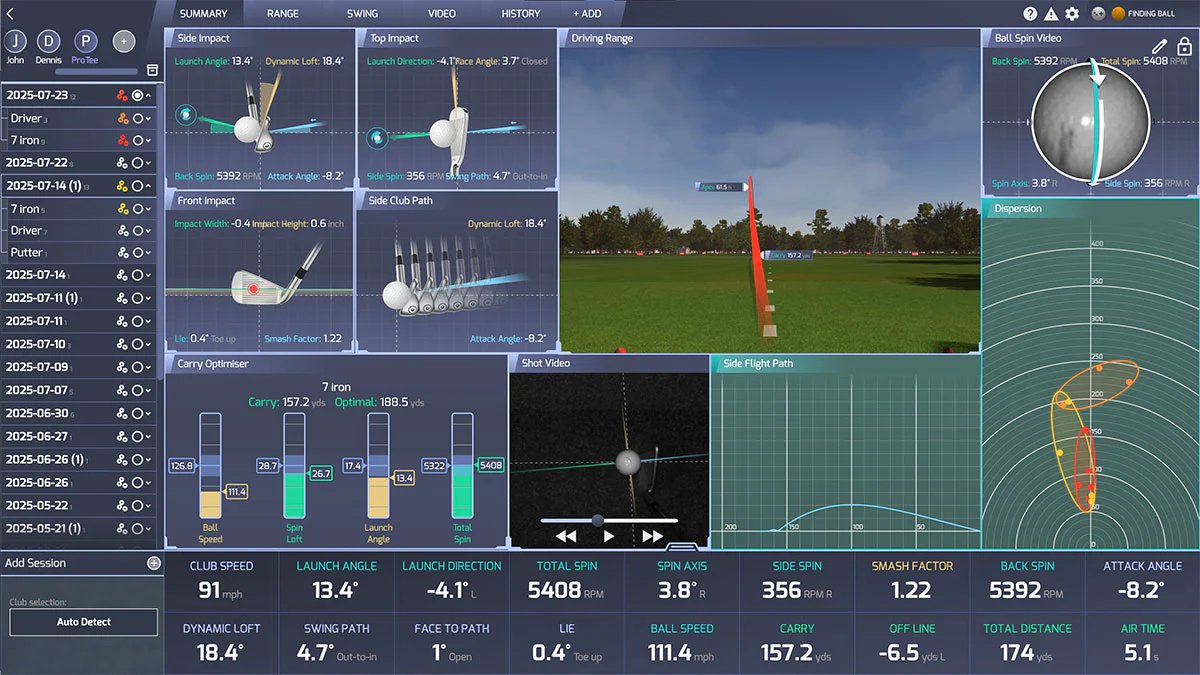
Golf simulator accuracy comes down almost entirely to the launch monitor behind it. A high-speed, camera-based system like the ProTee VX used at The Perch captures real clubhead and ball data at 1800 frames per second, which puts it on par with the monitors used for professional club fitting, not just casual play.
What Makes a Launch Monitor Accurate
The technology matters more than the brand name on the screen. Camera-based overhead systems watch the actual clubhead path and ball flight from above the hitting area, rather than estimating numbers from a partial radar signature. That's the difference between a system giving you real data and one giving you a rough approximation.
The ProTee VX at The Perch
Every bay runs the ProTee VX, which uses dual high-speed overhead cameras at 1800fps. It works with any ball and any club, no stickers, markers, or special equipment required. That matters for accuracy because nothing about your setup changes between a real range session and a session at The Perch.
What It Can and Can't Tell You
Ball speed, spin rate, launch angle, clubhead speed, and carry distance all come from direct measurement, not estimation, so those numbers hold up well against what you'd see at an outdoor fitting. What a simulator can't fully replicate is wind, true turf lies, and the exact feel of a real course. Software like The Golf Club, E6 Connect, and GSPro model those conditions well, but it's a simulation of them, not the real thing.
Does Accuracy Matter for Casual Play?
For a casual round with friends, close-enough accuracy is plenty, since the fun is in the course and the competition. For lessons, club fittings, or anyone trying to make a real swing change, accuracy is the whole point. That's where overhead camera data earns its keep, giving a PGA professional real numbers to work from instead of guesswork.
Curious what your own numbers look like? Book a lesson or fitting, or just reserve a bay and see for yourself.